Podcast
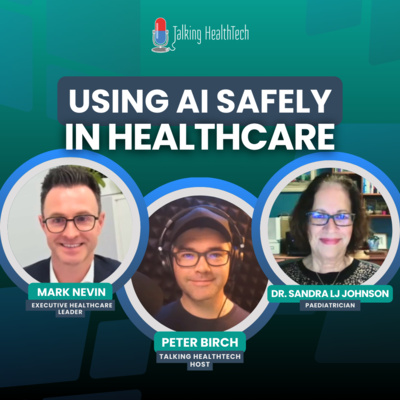
Talking HealthTech: 551 – Guardrails, Regulation and Responsibility: Using AI Safely in Healthcare
In this episode of Talking HealthTech, Peter Birch speaks with Mark Nevin, an executive leader and policy strategist in healthcare, and Dr. Sandra LJ Johnson, a paediatrician and expert in medical law, about the duties and responsibilities of the medical workforce in overseeing artificial intelligence (AI) in health services. The discussion explores the evolving regulatory landscape, medical duty of care, risk management, and the need for collaboration between clinicians, technologists, and regulators as AI becomes increasingly integrated into healthcare delivery.Key Takeaways? Regulation of AI in healthcare should be risk-based, leveraging existing frameworks while addressing the unique challenges posed by dynamic and learning systems.⚙️ The duty of care for clinicians extends to understanding the tools and technologies they use, including the basics of how AI systems are trained and their limitations.? Adoption of AI in clinical settings requires a holistic approach with multiple levels of guardrails—regulatory, specialist, clinician-patient, and consumer feedback—to ensure safety and accountability.?? Ongoing education and competency development are essential for clinicians, as medical colleges and educational bodies are now incorporating AI and digital health into their curricula.? Collaboration across disciplines—between clinicians, engineers, software developers, regulators, and consumers—is key to safe and effective AI adoption in healthcare.✒️ The complexity of liability in AI-driven care highlights the importance of clear governance and delineation of responsibilities among stakeholders before issues arise.? Australia is keeping pace with global advancements in AI regulation and implementation, drawing on strong collaboration between its scientific, medical, and regulatory communities.Check out the episode and full show notes on the Talking HealthTech website.Loving the show? Leave us a review, and share it with someone who might get some value from it. Keen to take your healthtech to the next level? Become a THT+ Member for access to our online community forum, meet ups, special offers and more exclusive content. For more information visit talkinghealthtech.com/thtplus
We’re excited to collaborate with New Zealand Trade & Enterprise (NZTE) to bring you a mini-series of episodes titled: “Exporting Innovation: NZ HealthTech”, exploring how New Zealand’s healthtech innovators are taking their ideas from home to the world.
This episode is part 1 of 3, so stay tuned for more episodes in the series coming soon!
In this episode of Talking HealthTech, Peter Birch and Rob Milsom from New Zealand Trade & Enterprise (NZTE) introduce Rei Ishikawa (Karo Data Management), Paris Majot (Orion Health), Phil Xue (Odin Health), and Nick Burns (2iQ Health).
The episode focuses on how New Zealand healthtech companies are powering smart healthcare through digital infrastructure, interoperability, and data-driven solutions, both at home and globally.
They cover themes like hospital capacity management, primary/community care innovation, digital integration at massive scale, and the role of credible AI in healthcare transformation.
Key Takeaways
?? NZTE highlights New Zealand’s approach to healthtech: innovative, necessity-driven, and values-led, with global ambition to solve hard problems in healthcare delivery.
? Odin Health’s journey from a small NZ operation to supporting over 450 million outpatient visits globally is driven by addressing real pain points in system integration, stability, and scalability.
? Real-world examples show how Norwegian digital infrastructure has been deployed not just in NZ but also at scale in large Chinese hospital settings, demonstrating the power and flexibility of Kiwi technology.
? Karo Data Management’s work underscores the importance of trust, indigenous values, and capturing holistic wellbeing data in primary and community care, making outcomes more relevant and reporting more meaningful.
? Orion Health’s focus is on seamless data connectivity, patient engagement, and operational analytics, supporting clinicians with unified clinical records and enabling large-scale AI-driven workflows for preventative care.
? 2iQ Health explores proactive public hospital capacity management, making hospital operations more efficient by anticipating demand patterns, maximising limited resources, and streamlining planning for leaders and clinicians.
? Across all companies, the importance of interoperability, real-time data access, cloud infrastructure, and patient-centred design is emphasised as vital for improving both patient outcomes and cost efficiency in healthcare systems.
? AI’s role is becoming increasingly important, but its effectiveness relies on access to quality, well-structured clinical data and meaningful integration into existing workflows.
? A global healthtech export mindset, rooted in strong local values, positions New Zealand companies to partner with Australian organisations and those beyond for scalable healthcare innovation.
Check out the episode and full show notes on the Talking HealthTech website.
Loving the show? Leave us a review, and share it with someone who might get some value from it. Keen to take your healthtech to the next level? Become a THT+ Member for access to our online community forum, meet ups, special offers and more exclusive content. For more information visit talkinghealthtech.com/thtplus
More episodes
-

Talking HealthTech: 646 – Patients as Partners: A Digital Approach to a Fairer, More Connected Surgical Journey
-
Talking HealthTech: 645 – Seamless Workflows and Safer Care: AI Integration in Healthcare with InterSystems
-
Talking HealthTech: 644 – Improving Patient Journeys: Clintel Systems and the Future of Digital Health in Australia